When I first got onto the computer this morning, it was just when the price of gold was shooting up in a nearly vertical line. As it turned out, it didn't have much farther to go, and was "only" headed to around $1,040 per ounce. But I didn't know what was going on and felt sick, wondering if Israel had bombed Iran or the Chinese had done something. Gold tends to go up in response to political turmoil, war, uncertainties about currency, and so on. It's true that it fell temporarily when the banking crisis hit late last year, because many people had to sell whatever they had that was liquid in order to meet obligations. But compared to other kinds of investments it has done amazingly well since the whole ball of yarn started unraveling in 2007.
Today's gold move was from about $1020 to an all-time record high of almost $1045. The reason for this, some speculate, is that journalist Robert Fisk -- one of my favorite journalists ever, by the way, constantly smeared by other Western journalists because he won't toe the line -- broke the news that a number of countries were meeting in secret to discuss moving away from the US dollar as the only currency in which to trade oil.
You may have heard the term "petrodollar," short for "petroleum-backed dollar." The idea is, since everybody but everybody needs oil, and you can only buy the stuff using dollars, everybody needs dollars. This maintains the dollar's status as reserve currency and it also supports its value by insuring demand.
If oil is routinely sold in anything other than dollars, then nobody has to have dollars anymore.
Most Americans don't have any clue what kind of danger our currency is in. They know about unemployment, bank bailouts, falling wages, store closings. But the idea that everything at China-Mart could double in price in 6 months (to choose a random hypothetical example) is not on their radar.
All of that said, I don't think this is "the big one," the point at which gold skyrockets and the dollar tanks, never to return. I still expect a stocks crash, a short dollar rally, and a major pullback in gold (although this pullback could be less than I'd been thinking, because the Chinese stand ready to buy gold whenever the price gets attractively low).
Silver, by the way, is known as the "poor man's gold," for being so much cheaper. It is currently undervalued relative to gold, meaning that not only are both precious metals expected to rise over the coming years, but silver should rise by even more. I wouldn't buy any silver just yet, because it could go off a cliff again if we have something similar to the fall of 2008. But if the price drops, go out and snatch up whatever silver you can. Sometime in the next few years (and possibly pretty soon) the world's post-WWII dollar system will fail.
Tuesday, October 6, 2009

Monday, October 5, 2009
Young and restive
One thing you do not want, if you're a politician, is a whole slew of unemployed, impoverished youth. They don't have a lot to lose, but they do have plenty of energy. Piss them off and you could have a situation on your hands.
With that in mind, this news from the Telegraph seems fairly alarming:
Ignored, but not forever. In cases of massive unrest (as in Argentina) you see every kind of person on the streets, including elderly women banging pots with spoons. But in the early stages of unrest, in which windows are broken and cars torched, it's young people who carry it out. Consider Greece:
In 2005, riots broke out in many French cities and towns after police killed two teenagers. In that instance, racism and immigration played a role, but those issues are very much intertwined with unemployment and poverty. Young people are disproportionately without jobs and in poverty, both in the US and Europe, and young people have less to lose than older adults.
As the Barclay's economist said above, politicians have felt pretty safe ignoring teenagers and twenty-somethings. They don't vote (much) and have no lobbyists. But having this attitude today, as the world slips into economic Depression, is amazingly blithe.
Here in the US, the situation is worse than Spain or similar to Eastern Europe, depending on the color of your skin:
Like I said, racism, immigration, poverty, unemployment-- it's all interconnected, and it's a tinderbox. (It would be helpful if police the world over would stop killing unarmed teenagers, which tends to spark violence; but I'm not optimistic.)
Having some sort of mandatory military service (as the White House Chief of Staff wants), or mandatory civil volunteering, or any other sort of "youth brigade" could become a popular idea if we begin to see destructive protests among teenagers and young adults. (One wonders about the color of their uniforms and whether they will have a special salute?) The military poverty draft is already useful to the establishment as a means of neutralizing -- in one way or another -- poor and potentially angry teenagers.
The thing to get into our heads, I suppose, is that the kids we will one day see on television throwing the tear gas canisters back into the police ranks would truly rather be working, making a living and making their way in the world. In some ways the US is better off than Europe in the longer term, because although we don't produce anything now, we could start making stuff. And that will eventually provide more jobs for those who are 17 or 19 today.
With that in mind, this news from the Telegraph seems fairly alarming:
Youth unemployment has reached 39pc in Spain, 31pc in Lithuania, 28pc in Latvia, 26pc in Ireland and Slovakia, 25pc in Italy and Hungary, 24pc in France.
"There's tragedy unfolding here," said Julian Callow, Barclay’s Europe economist. "This is going to haunt the political outlook for years to come. Europe has been in denial about this because youth are not a powerful lobby like the unions, so they can be ignored.
Ignored, but not forever. In cases of massive unrest (as in Argentina) you see every kind of person on the streets, including elderly women banging pots with spoons. But in the early stages of unrest, in which windows are broken and cars torched, it's young people who carry it out. Consider Greece:
Data showed on Thursday nearly 18 percent of 15-29 year old Greek workers were unemployed in the second quarter, compared with 8.9 percent for the whole population and strongly up from last year.
The issue has proven explosive in the past. Last year leftists and young students took to the streets in Greece's worst riots in decades over the economy and the killing of a teenager by police. (source)
In 2005, riots broke out in many French cities and towns after police killed two teenagers. In that instance, racism and immigration played a role, but those issues are very much intertwined with unemployment and poverty. Young people are disproportionately without jobs and in poverty, both in the US and Europe, and young people have less to lose than older adults.
As the Barclay's economist said above, politicians have felt pretty safe ignoring teenagers and twenty-somethings. They don't vote (much) and have no lobbyists. But having this attitude today, as the world slips into economic Depression, is amazingly blithe.
Here in the US, the situation is worse than Spain or similar to Eastern Europe, depending on the color of your skin:
The September teen unemployment rate hit 25.9%, the highest rate since World War II and up from 23.8% in July. Some 330,000 teen jobs have vanished in two months. Hardest hit of all: black male teens, whose unemployment rate shot up to a catastrophic 50.4%. It was merely a terrible 39.2% in July. (source)
Like I said, racism, immigration, poverty, unemployment-- it's all interconnected, and it's a tinderbox. (It would be helpful if police the world over would stop killing unarmed teenagers, which tends to spark violence; but I'm not optimistic.)
Having some sort of mandatory military service (as the White House Chief of Staff wants), or mandatory civil volunteering, or any other sort of "youth brigade" could become a popular idea if we begin to see destructive protests among teenagers and young adults. (One wonders about the color of their uniforms and whether they will have a special salute?) The military poverty draft is already useful to the establishment as a means of neutralizing -- in one way or another -- poor and potentially angry teenagers.
The thing to get into our heads, I suppose, is that the kids we will one day see on television throwing the tear gas canisters back into the police ranks would truly rather be working, making a living and making their way in the world. In some ways the US is better off than Europe in the longer term, because although we don't produce anything now, we could start making stuff. And that will eventually provide more jobs for those who are 17 or 19 today.
Saturday, October 3, 2009
Nothing has been fixed
I listened to a great interview today with one of my favorite financial commentators, Jim Willie. It's about a half hour long, but if you have time to listen, you certainly won't be bored.
The theme of the interview is that "green shoots" are a joke, because we have not fixed anything. We haven't increased US production. We are not, in truth, really trying very hard to halt foreclosures. Nothing has been done about derivatives, many of which are a kind of insurance against rising interest rates. If interest rates do rise, as at some point they must, it will obliterate the major banks (again). The central banks are already talking about how to repair the derivatives nightmare with -- you guessed it -- newly printed bailout money.
The most striking thing Willie said was that he thinks the Fed is buying 60 to 80% of all Treasuries. Holy cow. If that is true, there is no way to avoid Weimar now. It's too late.
No, nothing has been fixed, unless you think printing money is the solution to every problem.
You'd better have food stored.
If you start accumulating things now, picking up extra TP and some canned soup and a bag of dried beans every time you go to the store, or taking advantage of that sale on batteries or the 2-for-1 fleece blankets, you have time enough to gather a good deal together. If you think this is silly, visit some preparedness sites to see what the other end of the spectrum looks like.
The theme of the interview is that "green shoots" are a joke, because we have not fixed anything. We haven't increased US production. We are not, in truth, really trying very hard to halt foreclosures. Nothing has been done about derivatives, many of which are a kind of insurance against rising interest rates. If interest rates do rise, as at some point they must, it will obliterate the major banks (again). The central banks are already talking about how to repair the derivatives nightmare with -- you guessed it -- newly printed bailout money.
The most striking thing Willie said was that he thinks the Fed is buying 60 to 80% of all Treasuries. Holy cow. If that is true, there is no way to avoid Weimar now. It's too late.
No, nothing has been fixed, unless you think printing money is the solution to every problem.
You'd better have food stored.
If you start accumulating things now, picking up extra TP and some canned soup and a bag of dried beans every time you go to the store, or taking advantage of that sale on batteries or the 2-for-1 fleece blankets, you have time enough to gather a good deal together. If you think this is silly, visit some preparedness sites to see what the other end of the spectrum looks like.
Friday, October 2, 2009
But wait, it gets worse
Economists' estimates of how many jobs we lost in September have ranged from 100,000 jobs lost to 260,000 jobs lost, with a median estimate of 175,000. Pretty bad, especially considering that the working-age population is growing and we would need to add jobs every month just to keep unemployment rates from rising.
This morning the actual number came in at 263,000 jobs lost last month. Worse than the worst of economists' estimates, and a heck of a lot worse than the median prediction. Most likely, this number will be revised in the next month or two and will look even worse still, as that's what usually happens.
Of course, these numbers are the finagled, "adjusted" numbers. The government uses the "birth-death model" (meaning the birth or death of businesses) to change the estimate. Much later, after certain tax data has become available, they can tell us whether their adjustments got us any closer to the truth. Well, the government thinks that from March 2008 to March 2009 we actually lost 824,000 more jobs than their "adjusted" estimates had thought. So you can bet that this 263,000 figure is considerably too rosy, as well.
Karl Denninger has looked at some of the unadjusted data (all emphasis his):
It also turns out that average hours worked per week (among those lucky enough to be employed) fell another tenth of an hour, with a corresponding small decline of $1.54 in average weekly income. It's a tiny decrease per individual, but multiply that by 140 million workers and you get $216 million per week which is no longer available for consumer spending. That income loss does not count the unemployed; that's the income loss per week among those who still have jobs.
To have a real recovery the working and middle classes must have larger incomes, which means we must have higher wages and less unemployment. That means we must produce more. No more "service economy" or "post-industrialist economy" nonsense.
(It's true that there's one other way to become wealthier as a nation, and that's to simply loot and plunder other nations. But I think America's days as an empire are coming to an end, so that's out.)
No other choice but to grow things, mine things, and make things.
This morning the actual number came in at 263,000 jobs lost last month. Worse than the worst of economists' estimates, and a heck of a lot worse than the median prediction. Most likely, this number will be revised in the next month or two and will look even worse still, as that's what usually happens.
Of course, these numbers are the finagled, "adjusted" numbers. The government uses the "birth-death model" (meaning the birth or death of businesses) to change the estimate. Much later, after certain tax data has become available, they can tell us whether their adjustments got us any closer to the truth. Well, the government thinks that from March 2008 to March 2009 we actually lost 824,000 more jobs than their "adjusted" estimates had thought. So you can bet that this 263,000 figure is considerably too rosy, as well.
Karl Denninger has looked at some of the unadjusted data (all emphasis his):
But the Household Data is VASTLY worse than reported. Here are the month-over-month changes, and they're in the realm of frightening. (all numbers in thousands)
Civilian Labor Force: 154,879 to 153,617 this month.
Employed: 140,074 down to 139,079 this month.
That's a loss of 995,000 jobs, not 263,000, and the labor force contracted by 1,262,000 people!
The participation rate was absolutely decimated, down 0.6% this last month alone. The people "not in the labor force" rose by a staggering 1,516,000 in the last month.
The government doesn't count people as "unemployed" who have given up and exited the labor force, but as I have repeatedly noted, whether the government counts them or not, the corner store owner sure as hell does!
The fact of the matter is that nearly 1 million fewer people were working in September as compared to August; there has been absolutely no improvement in that trend whatsoever.
It also turns out that average hours worked per week (among those lucky enough to be employed) fell another tenth of an hour, with a corresponding small decline of $1.54 in average weekly income. It's a tiny decrease per individual, but multiply that by 140 million workers and you get $216 million per week which is no longer available for consumer spending. That income loss does not count the unemployed; that's the income loss per week among those who still have jobs.
To have a real recovery the working and middle classes must have larger incomes, which means we must have higher wages and less unemployment. That means we must produce more. No more "service economy" or "post-industrialist economy" nonsense.
(It's true that there's one other way to become wealthier as a nation, and that's to simply loot and plunder other nations. But I think America's days as an empire are coming to an end, so that's out.)
No other choice but to grow things, mine things, and make things.
Thursday, October 1, 2009
Choose your poison
So here's a bit of math that doesn't look too good.
The US Treasury would like to borrow $138 billion next week. That is, they want to print some IOU's and take people's money and promise to return it with interest.
Recently, the Federal Reserve has been providing almost half of these loans to the US government, using brand new money, invented out of thin air. It's not that the Fed really wants the IOU's, it's that nobody else wants them.
This arrangement with the Fed is known as "quantitative easing" or QE. (A leading Scottish money manager recently said: "Quantitative easing is a phrase which bears the same relationship to ‘printing money’ as ‘terminological inexactitude’ does to ‘lie’.")
Trouble is, QE was not an infinite program. The Fed says it's being wrapped up now and is coming to an end. Only $7 billion more can be spent buying Treasuries this way. And -- not to belabor the obvious -- but $7 billion is a far cry from half of $138 billion.
So what if we can't sell our IOU's for some fast cash? What happens if people look over the Treasuries and say "No thanks," and there's no Fed to ride in and save us?
Well, they wouldn't exactly say "No," they'd say "You look like a shady character, so I'll give you the money, but only if you pay me a heck of a lot of interest to make it worth the risk." So instead of borrowing money at some measly amount like 2%, we get the loan all right, but we have to pay 4%. Or 6%. Or 10%. Who knows, once confidence is lost?
This is Poison #1: Rising Interest Rates. The housing market was just starting to pop its head out of the bunker to see if the smoke had cleared, and here come high interest rates to discourage home sales, make refinancing even less feasible, and crush adjustable-rate mortgage holders. Not good. And the federal budget deficit would balloon even more quickly than it has been.
Alternatively, we could simply revert back to QE again and let the Fed step in and buy debts within a new, emergency round of money-printing. This is Poison #2, and it would be very risky. Words like "Armageddon" are being used (video) to describe what happens if we piss off China and Japan enough that they start refusing to buy our bonds. And they would certainly be pissed. Nobody wants to be paid back in Weimar-like currency, which is to say, kindling. Run the printing press enough, and you're on the path to currency collapse.
Poison #3 has political and economic ramifications, but is the least unpredictable and least chaotic of the options. And it would cause a dollar rally, smash the gold price temporarily, and please our foreign creditors. It's the simplest thing, really-- you just push the stock market off a cliff. Have Goldman hurry it along so it can be out of the way by Oct 7 or 8 when we have to sell some longer-duration IOU's that nobody would otherwise buy. Make stocks plummet (which was inevitable anyway, just a matter of timing), and investors and fund managers panic and race into Treasuries as a "safe haven." Problem solved, for the time being.
Of course, political approval ratings and consumer confidence are heavily dependent on stock markets. Pension funds, 401k's, university endowment funds, and some municipal funds will all suffer. It's not good political policy to enrage the middle class, as it's the middle classes who engender revolutions. But the first two options risk chaos on the international scene. Nobody likes the dollar, but as it is the world's reserve currency and foreigners are in possession of around 2/3 of all dollars in existence, everyone would prefer that it die an orderly death.
So that's how I see the dangers in the next 10 days. (There may be a less awful scenario that I haven't thought of, like working out a back-room deal with EU nations, but I can't envision how that would work.) We could see rising interest rates, or money-printing and a plunging dollar, or a crash in stocks bad enough to cause panic. If you've been reading the blog, you know how I feel about stocks.
[Addendum: Immediately after posting I went to Zero Hedge and saw that Goldman just revised its estimate of job losses from 200,000 jobs gone to 250,000 jobs gone. A bad jobs number, coming on top of today's bad day in stocks and other bad econ data this week, could set off the downturn in equities.]
The US Treasury would like to borrow $138 billion next week. That is, they want to print some IOU's and take people's money and promise to return it with interest.
Recently, the Federal Reserve has been providing almost half of these loans to the US government, using brand new money, invented out of thin air. It's not that the Fed really wants the IOU's, it's that nobody else wants them.
This arrangement with the Fed is known as "quantitative easing" or QE. (A leading Scottish money manager recently said: "Quantitative easing is a phrase which bears the same relationship to ‘printing money’ as ‘terminological inexactitude’ does to ‘lie’.")
Trouble is, QE was not an infinite program. The Fed says it's being wrapped up now and is coming to an end. Only $7 billion more can be spent buying Treasuries this way. And -- not to belabor the obvious -- but $7 billion is a far cry from half of $138 billion.
So what if we can't sell our IOU's for some fast cash? What happens if people look over the Treasuries and say "No thanks," and there's no Fed to ride in and save us?
Well, they wouldn't exactly say "No," they'd say "You look like a shady character, so I'll give you the money, but only if you pay me a heck of a lot of interest to make it worth the risk." So instead of borrowing money at some measly amount like 2%, we get the loan all right, but we have to pay 4%. Or 6%. Or 10%. Who knows, once confidence is lost?
This is Poison #1: Rising Interest Rates. The housing market was just starting to pop its head out of the bunker to see if the smoke had cleared, and here come high interest rates to discourage home sales, make refinancing even less feasible, and crush adjustable-rate mortgage holders. Not good. And the federal budget deficit would balloon even more quickly than it has been.
Alternatively, we could simply revert back to QE again and let the Fed step in and buy debts within a new, emergency round of money-printing. This is Poison #2, and it would be very risky. Words like "Armageddon" are being used (video) to describe what happens if we piss off China and Japan enough that they start refusing to buy our bonds. And they would certainly be pissed. Nobody wants to be paid back in Weimar-like currency, which is to say, kindling. Run the printing press enough, and you're on the path to currency collapse.
Poison #3 has political and economic ramifications, but is the least unpredictable and least chaotic of the options. And it would cause a dollar rally, smash the gold price temporarily, and please our foreign creditors. It's the simplest thing, really-- you just push the stock market off a cliff. Have Goldman hurry it along so it can be out of the way by Oct 7 or 8 when we have to sell some longer-duration IOU's that nobody would otherwise buy. Make stocks plummet (which was inevitable anyway, just a matter of timing), and investors and fund managers panic and race into Treasuries as a "safe haven." Problem solved, for the time being.
Of course, political approval ratings and consumer confidence are heavily dependent on stock markets. Pension funds, 401k's, university endowment funds, and some municipal funds will all suffer. It's not good political policy to enrage the middle class, as it's the middle classes who engender revolutions. But the first two options risk chaos on the international scene. Nobody likes the dollar, but as it is the world's reserve currency and foreigners are in possession of around 2/3 of all dollars in existence, everyone would prefer that it die an orderly death.
So that's how I see the dangers in the next 10 days. (There may be a less awful scenario that I haven't thought of, like working out a back-room deal with EU nations, but I can't envision how that would work.) We could see rising interest rates, or money-printing and a plunging dollar, or a crash in stocks bad enough to cause panic. If you've been reading the blog, you know how I feel about stocks.
[Addendum: Immediately after posting I went to Zero Hedge and saw that Goldman just revised its estimate of job losses from 200,000 jobs gone to 250,000 jobs gone. A bad jobs number, coming on top of today's bad day in stocks and other bad econ data this week, could set off the downturn in equities.]
Sunday, September 27, 2009
Headlines from the Real Economy
US Job Seekers Exceed Openings by Record Ratio
35 Million Americans on Food Stamps
A Surge in Homeless Children Strains Schools
Meanwhile, in La-La Land, we have headlines like this:
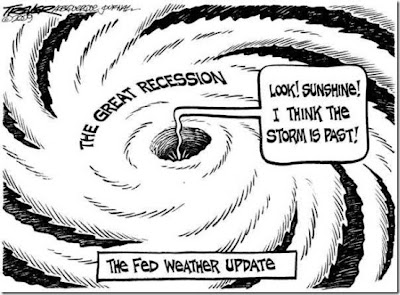
Bernanke: Recession "Likely Over"

So we sold more cars. Yeah, no kidding! That was part of a little thing called Cash for Clunkers. (Notice, however, that even with Cash for Clunkers we still sold slightly fewer cars than in August 2008.) And we sold more gasoline too, although notice that compared to August 2008, gas stations sold 27% less (wow!!). And, continuing down the chart, 6 of the next 7 "better than July" categories were also down compared to the same month in 2008.
Econo-bloggers have started to comment on this trend of looking only at month-to-month changes, which sometimes show small improvements, rather than the usual year-over-year changes. Because of simple variability and certain seasonal trends, there's usually some economic statistic somewhere which showed a slight improvement since last month. It's the year-over-year figures that show we've not had any real recovery.
Back to the chart-- the remaining improved category of restaurant and bar sales, which actually was up even on a y-o-y basis, was surely not enough to outweigh the drops in building materials, garden supplies, furniture, and furnishings.
Basically we're hanging our "recession is over!" hats on a measly 0.3% increase in fast food purchases and bar tabs from July to August. Or, to be fair, a 0.7% increase compared to August 2008.
Damn slim data on which to come out publicly and declare the end of the recession. Mr. Bernanke needs to take his egghead out of the ivory tower and go spend a weekend in a place like Gary, Indiana or Flint, Michigan.
-- Harvard Economic Society, January 18, 1930
[U]nemployed Americans now confront a job market that is bleaker than ever in the current recession, and employment prospects are still getting worse.14.5 million unemployed does not count the long-term unemployed or those who have given up because there are no jobs in their area. The real ratio of unemployed to available jobs might be closer to 10 to 1.
Job seekers now outnumber openings six to one, the worst ratio since the government began tracking open positions in 2000. According to the Labor Department’s latest numbers, from July, only 2.4 million full-time permanent jobs were open, with 14.5 million people officially unemployed.
35 Million Americans on Food Stamps
The raw data shows us that a stunning 12 percent of our entire population is receiving some form of food stamp assistance.... This is the highest percentage of Americans receiving food stamps since records started being kept back in 1969.
A Surge in Homeless Children Strains Schools
Charity [Crowell] is one child in a national surge of homeless schoolchildren that is driven by relentless unemployment and foreclosures. The rise, to more than one million students without stable housing by last spring, has tested budget-battered school districts as they try to carry out their responsibilities — and the federal mandate — to salvage education for children whose lives are filled with insecurity and turmoil....Housing Crash to Resume on 7 Million [New] ForeclosuresWhile current national data are not available, the number of schoolchildren in homeless families appears to have risen by 75 percent to 100 percent in many districts over the last two years....
With schools just returning to session, initial reports point to further rises. In San Antonio, for example, the district has enrolled 1,000 homeless students in the first two weeks of school, twice as many as at the same point last year [emphasis mine].
The crash in U.S. home prices will probably resume because about 7 million properties that are likely to be seized by lenders have yet to hit the market.....
The "huge shadow inventory," reflecting mortgages already being foreclosed upon or now delinquent and likely to be, compares with 1.27 million in 2005.....
Assuming no other homes are on the market, it would take 1.35 years to sell the properties based on the current pace of existing-home sales....
Meanwhile, in La-La Land, we have headlines like this:
Bernanke: Recession "Likely Over"
Federal Reserve Chairman Ben Bernanke said Tuesday that the recession was "very likely over," as consumers showed some of the first tangible signs of spending again.These "tangible signs of spending," which apparently prompted Bernanke to pronounce the end of the recession, were based on August retail sales figures. That is, August sales looked better than July sales. Of course, as usual with government statistics, it was all the sheerest nonsense. Let's take a look at this August data:

So we sold more cars. Yeah, no kidding! That was part of a little thing called Cash for Clunkers. (Notice, however, that even with Cash for Clunkers we still sold slightly fewer cars than in August 2008.) And we sold more gasoline too, although notice that compared to August 2008, gas stations sold 27% less (wow!!). And, continuing down the chart, 6 of the next 7 "better than July" categories were also down compared to the same month in 2008.
Econo-bloggers have started to comment on this trend of looking only at month-to-month changes, which sometimes show small improvements, rather than the usual year-over-year changes. Because of simple variability and certain seasonal trends, there's usually some economic statistic somewhere which showed a slight improvement since last month. It's the year-over-year figures that show we've not had any real recovery.
Back to the chart-- the remaining improved category of restaurant and bar sales, which actually was up even on a y-o-y basis, was surely not enough to outweigh the drops in building materials, garden supplies, furniture, and furnishings.
Basically we're hanging our "recession is over!" hats on a measly 0.3% increase in fast food purchases and bar tabs from July to August. Or, to be fair, a 0.7% increase compared to August 2008.
Damn slim data on which to come out publicly and declare the end of the recession. Mr. Bernanke needs to take his egghead out of the ivory tower and go spend a weekend in a place like Gary, Indiana or Flint, Michigan.
[T]here are indications that the severest phase of the recession is over.
-- Harvard Economic Society, January 18, 1930
Saturday, September 26, 2009
Overpriced stocks
One measure of whether stocks are over- or under-valued at current prices is the P/E or price-to-earnings ratio. If a stock costs $10/share, and the company is earning $2/share, then the P/E is 10/2 or 5. This would usually mean that stock is priced pretty cheap. If the ratio is more like 40 then the price would typically be considered too high, based on what the company is earning.
Bearing that in mind, take a look at these hideous graphs (click to enlarge), from a long report titled Economic and Financial System Train Wreck Dead Ahead:

It's not that stock prices have gone up astronomically. The Dow and S&P (which are aggregate price measures) are still far below the highs they reached in 2007. What's happened, of course, is that earnings have plunged precipitously:

Check out the x-axis. This chart goes back 75 years. Nothing even remotely like this has happened since the Great Depression.
So why have stocks kept up these price levels? If earnings are down 98% since the 2007 highs, why are stocks down only around a third? Is this why Congressman Grayson asked the Fed whether they manipulate stock markets?
Stocks have not been rallying because there is any sort of recovery underway. Numbers may tack up or down a little bit, they may vary from one month to the next, they may appear to improve temporarily because of bailouts or foreclosure moratoriums or Cash for Clunkers. But there is no recovery. Eventually stocks will have to "correct" to reflect reality.
Bearing that in mind, take a look at these hideous graphs (click to enlarge), from a long report titled Economic and Financial System Train Wreck Dead Ahead:

It's not that stock prices have gone up astronomically. The Dow and S&P (which are aggregate price measures) are still far below the highs they reached in 2007. What's happened, of course, is that earnings have plunged precipitously:

Check out the x-axis. This chart goes back 75 years. Nothing even remotely like this has happened since the Great Depression.
So why have stocks kept up these price levels? If earnings are down 98% since the 2007 highs, why are stocks down only around a third? Is this why Congressman Grayson asked the Fed whether they manipulate stock markets?
Stocks have not been rallying because there is any sort of recovery underway. Numbers may tack up or down a little bit, they may vary from one month to the next, they may appear to improve temporarily because of bailouts or foreclosure moratoriums or Cash for Clunkers. But there is no recovery. Eventually stocks will have to "correct" to reflect reality.

Subscribe to:
Posts (Atom)